
Confederation of Indian Textile Industry (CITI) Contribution to Skill Development

Confederation of Indian Textile Industry (CITI) works as an interface between the Government of India and Industry. It helps government in providing policy inputs to the government and simultaneously support the Textile and Garment sector by protecting their interests by bringing amendments in government policies.

CITI as a board member of the National Skill Development Corporation (NSDC) and a promoter of the Textile Sector Skill Council (TSC), plays a pioneering role in creating and enhancing the availability of skilled force for the Textile and Garment sector.

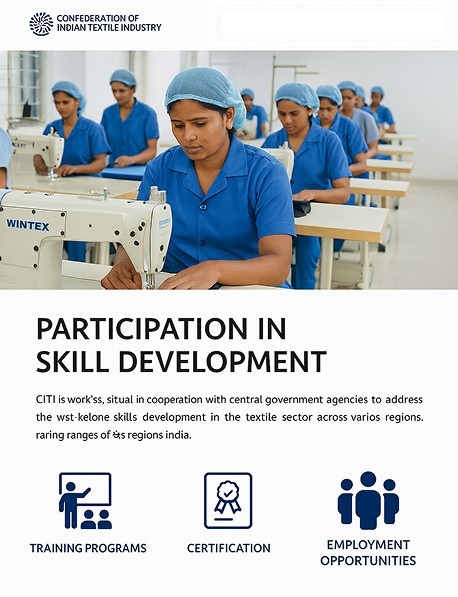
CITI itself enters the skill development through the Samarth Scheme, Ministry of Textiles (MoT) and PMKVY Scheme, Ministry of Skill Development and Entrepreneurship (MSDE) to facilitate the Industries to impart the right kind of training to workers on state-of-the-art technologies.

Keeping the industry demand in mind of having a pool of skilled workforce ready for achieving the ambitious targets set for the Textile and Garment sector. The primary objective of CITI is to develop world-class skilled manpower for all segments of textile manufacturing starting from Textile and Garment finishing which includes the organized Textile and Garment industries.

1
Trainees Trained
1
Trainees Certified
1
Trainers Certified
1
Affiliated Training Centres

Samarth (Scheme for Capacity Building in Textile Sector)

Samarth (Scheme for Capacity Building in Textile Sector) is a flagship skill development scheme approved in continuation to the Integrated Skill Development Scheme for 12th FYP, Cabinet Committee of Economic Affairs. The industry is facing shortage of skilled workers and provides many opportunities for unemployed youth in the country who are trained in the sector. To address the issue, Central government of India has launched Scheme for Capacity Building in Textile Sector (SCBTS) and named it SAMARTH Scheme.

Objectives of the Samarth Scheme

  • Introduce demand-driven skilling programmes aligned with current and future industry requirements.
  • Ensure all training programmes are placement-oriented to improve employability outcomes.
  • Implement skilling initiatives in compliance with the National Skills Qualifications Framework (NSQF).
  • Promote inclusive skilling for SC, ST, women, and marginalized communities to support wage employment.
  • Support and supplement industry efforts in generating employment within the organized textile and Garment sectors.
  • Cover the entire textile value chain, while excluding spinning and weaving activities.
  • Strengthen workforce capacity in Textile and Garment Industries.
  • Promote skill upgradation to enhance productivity and income levels.
  • Create opportunities for sustainable livelihoods through wage employment.
  • Ensure inclusive skilling and livelihood support.

PMKVY (Pradhan Mantri Kaushal Vikas Yojana)

Pradhan Mantri Kaushal Vikas Yojana (PMKVY) is the flagship scheme of the Ministry of Skill Development and Entrepreneurship (MSDE). The objective of this Skill Certification scheme is to enable Indian youth to take up industry relevant skill training that will help them in securing a better livelihood.

PMKVY 4.0 under the umbrella scheme of the ‘Skill India Programme’ is being implemented between FY 2022-2026. PMKVY 4.0 is being realigned with a core focus on making the existing skill ecosystem more flexible, swift, and geared to meet the current challenges and emerging needs through process simplification.

Objectives of PMKVY

  • Create an enabling ecosystem for youth to acquire skills aligned with their abilities and career aspirations.
  • Deliver market-oriented, demand-driven skill training by making the skilling ecosystem flexible, responsive, and employment-focused.
  • Simplify processes in the skill ecosystem through technology and digitalization.
  • Expand access to skilling infrastructure in remote and difficult geographies through targeted and special projects.
  • Promote inclusive skilling for SC, ST, women, and marginalized communities to support wage employment.
  • Enable lifelong learning through continuous upskilling and reskilling to meet evolving market needs.
  • Ensure quality training delivery through trained faculty, standardized assessments, and industry-relevant curricula.
  • Enhance employability by developing transferable skills and incentivizing employment generation.
  • Adopt a candidate-centric approach with a strong focus on industry-relevant skills.

Types of Training

Short-Term Training (STT):

Candidates looking for fresh skilling, out of-education candidates, School/college dropouts or unemployed youth of Indian nationality. Short Term Training provided under NSQF aligned courses ranging between 300 – 600 hours. Courses of higher duration based on industry/sectoral demand can also be offered. Training to be delivered through accredited and affiliated training centres. On-Job Training (OJT) will be an inherent component under STT, and the duration of OJT will depend on the job role.

Upskilling through (RPL)

Candidates with prior learning experience or skills will be certified with due assessment. This shall enable youths to obtain industry relevant skill certification. Emphasis will be on upskilling and interested candidates will have to undergo coursework for certification at a higher level based on assessment.

Special Projects:

Special Projects are project-based short-term skilling initiatives that primarily meet the skilling needs of marginalized and vulnerable groups, difficult geographies and specialized training courses which are likely to be offered outside of regular short-term skilling programmes. Also, these projects can have focus on new-age job roles with future skills. These projects can avail certain exemptions granted with the approval of the Executive Committee, and they can also be residential or non-residential.

Scheme Samarth PMKVY
Short Term Training Special Projects Upskilling through (RPL
Target Group Candidates looking for fresh skilling, out-of-education candidates, School/college dropouts or unemployed youth of Indian nationality. Marginalized, vulnerable groups, etc. requiring special attention or job-roles with focus on future skills. Candidates with prior learning experience or skills and willing to get assessed and certified
Eligibility Indian nationals possessing valid Aadhaar and fulfilling eligibility criteria of respective. Indian nationals possessing valid Aadhaar and fulfilling eligibility criteria of the respective job role. In case of RPL, prior experience will be required in the job role for which RPL certification is being sought and as specified in the job role
Age Group 18- 50 years 15 - 45 years 18- 59 years

How to Become a Partner

We hereby invite your participation for the project, where CITI will nominate training infrastructure available at your units to be affiliated under the said scheme. Affiliated training centres; after due approval; can impart training and avail financial benefits under the scheme.

For any further information / query regarding the Samarth & PMKVY Scheme, kindly contact Mr. Amit Kumar, Deputy Secretary at +91-9212121265, E: amit@citiindia.org

keyboard_arrow_up